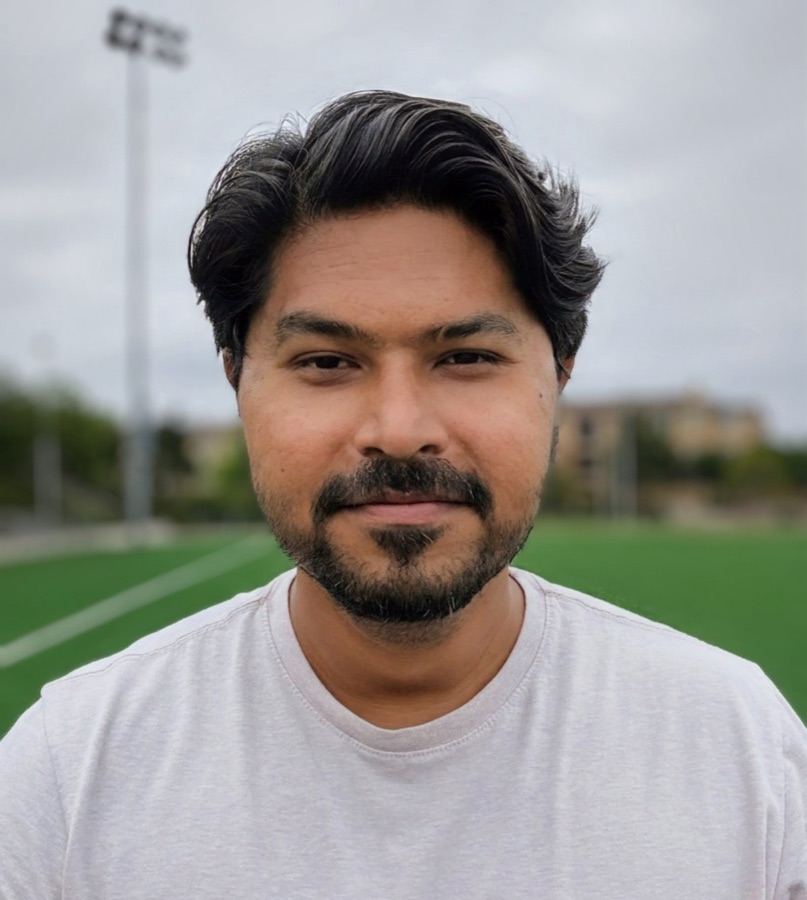
Anurup Ganguli
Engineer · Researcher · Founder, learnerlabs.ai
About me
As scientists and researchers, we get comfortable doing things we are already very good at, and tie our identity and reputation to our excellence in that narrow domain. Most of my decisions can be understood as the pursuit of a set of questions:
- What else can I do?
- What else can I contribute to the world?
- What else might I enjoy?
That is the exploration part. I hold it in balance with a second set:
- Am I working on the most impactful thing I can contribute to?
- Am I at my ceiling of contribution?
These two sets of questions together have governed my decisions for most of my life.
The PhD years
I studied mechanical engineering at IIT Jodhpur and then briefly took a role at Flipkart optimizing their warehouse operations for the sports category before coming to the US for a PhD in bioengineering. The decision to do a PhD was mostly driven by a desire to learn biology and truly understand how the body works. I've always had a knack for acing exams without studying much, and until then (I was 22), I never really had to question most of my learning goals.
When I came for a PhD, I felt like a mad scientist on steroids. I secured a small $150K grant from MGH (Massachusetts General Hospital) in my second year of PhD (it felt pretty big at the time), and thanks to an understanding advisor, I was able to work on pretty much anything my heart desired. And so I did.
My work spanned many topics including below:
- Tissue engineering (Science Advances - “Three-dimensional microscale hanging drop arrays with geometric control for drug screening and live tissue imaging”)
- Cancer microarrays (Nature Communications - “Pixelated spatial gene expression analysis from tissue”)
- Building microchips and sensors for biological assays (PNAS - “Rapid isothermal amplification and portable detection system for SARS-CoV-2”; PNAS - “A culture-free biphasic approach for sensitive and rapid detection of pathogens in dried whole-blood matrix”)
- Transistors for sensing based on graphene or ISFETs (Advanced Functional Materials - “High Sensitivity Graphene Field Effect Transistor-Based Detection of DNA Amplification”; Biomedical Microdevices - “Robust label-free microRNA detection using one million ISFET array”)
In the process, I learned things from how to do a microsection of a rat brain to how to do a Bosch etch on silicon chips. The overall theme was applying principles from electrical, mechanical, materials and chemical engineering to biological systems and, in some cases, trying to engineer them. Five years later, I graduated with over 25 publications in top journals and more than 20 patents.
My first company
After my PhD, I started my first company, VedaBio (FKA LabSimply Inc.), spinning out one of my research platforms, which was based on CRISPR enzymes for diagnostic applications. I led the company as founder and CEO for the first 3+ years, built the initial team of 30 talented engineers and scientists, and raised $40M+.
Maybe just for context, by this time, I was an engineer who had wrestled with biology for more than a decade, and deeply understood cellular systems, and the memory within them, as engineering rules and systems. With that in mind, in 2024, I left to explore new ideas and go back to the same questions: What else can I do? Am I working on the most impactful thing I can contribute to?
Learning to build software
In the beginning, I worked on simple projects. I started with a software application, Tribl Shopping (my first).
The goal here was to understand questions like:
- What is good software?
- How does it work?
- How do you build one?
- What is marketing?
- How do you get users?
You see, for the last decade, I had only engineered atoms and worked with cells, but never bits and software. My exposure to coding was also limited to scientific applications and MATLAB. This was new and exciting, and it was fun to write something and immediately see the results on the screen. For someone who had always been an outdoorsy person and had never enjoyed sitting inside or working on a laptop, this enjoyment of a tight loop of learning and validation was addictive.
Tribl Shopping
Now, a quick segue to the idea behind Tribl Shopping. The concept was simple. I had always hated the hidden markup in grocery and delivery apps. The bet was that if we flipped the algorithm for batching, we could be fully transparent with the user, and the user could split the fees honestly with members of their batch, which I called a tribe. The delivery applications need the markups to cover for a fundamental unit economics problem in the industry. If one shopper picks up one order, it takes about 40 minutes, whereas shopping three orders from the same store takes about 55 minutes in total. Either way, you still have to pay the shopper about $15 to $20 an hour, depending on the state. But optimizing for on-demand delivery within a short turnaround time means there is no effective batching for most orders, and so the margins must come from hidden tactics like markups, which are not disclosed.
Now, back to the story. It took me 4 months to build the application, and then I marketed it and hand-delivered about 30 orders. That was enough for me to understand that I appreciated the learning, but that this was not something I cared about enough to enjoy doing long term. There was this specific instance when a customer was rightfully pissed about receiving broken eggs, and I, of course, gave them a gift card to apologize for the inconvenience. But, at the same time, I had a visceral realization that this was the business and that I didn't care about it. Moreover, mathematically, I would have needed about 100 users per zip code for the tribes to start forming naturally and for the economics to work.
After about three months of serving users on Tribl, I wound that down and went on to build two other applications, both more AI-native:
- WorkManga, an orchestration layer that would ingest and process all the data from a few different applications (see more).
- A voice agent for booking loads for a trucking company, Intrade Industries, based out of Fresno (watch the demo).
Going deeper into the architecture
By this point, I had gained the full maturity of a one-year-old infant in this field of bits. Thankfully, it became clear to me that, to answer the question, “Am I working on the most impactful thing I can contribute to?”, I had to go deeper into the AI architecture. I didn't really understand how it worked, and I felt that, with my time spent on cellular systems and understanding memory within them, I could uniquely contribute something interesting in that direction.
As any researcher would do, I read every paper I could get my hands on, starting in the 1980s, and spent a month just understanding the ebbs and flows the field of deep learning went through to get to where it is today. This was also the time when a lot of the fundamental modeling aspects of current architectures seemed incomplete to me, and with my background in biology, I formalized a hypothesis and began testing it. The goal of the new architecture was simple. Today's models and architectures were never built for continual learning, and something deep, architecturally and algorithmically, must change to make it work.
I basically dumped all the results of my first attempt into an arXiv preprint (TFGN, arXiv:2605.15053). I apologize in advance for the writing style. I was using AI to write a lot of the content, so I recommend using AI to transform it into your desired format.
Along the way, I became a dad, and watching my daughter learn has been one of my greatest joys, as well as the biggest inspiration for my architectural solution to continual learning. You forget how you yourself learned things in the first few years of your life. Watching her go from first imitating sounds to gradually forming words and then longer sentences has been pretty amazing.
Learner 1.0
I'm happy to announce the release of Learner 1.0, my solution to continual learning. It is built on new, biologically grounded architectural and algorithmic primitives that I believe do for continual adaptation of neural nets what attention does for long sequence modeling. I hope you enjoy reading the demonstrations as well as trying out the API.
Anurup Ganguli
Selected papers
First-author work, selected from ~30 peer-reviewed papers listed with the TFGN preprint first, then by journal impact factor (Clarivate Journal Citation Reports, most recent release). ~2,028 citations, h-index 17, inventor on 50+ issued and pending US patents. Full record on Google Scholar.